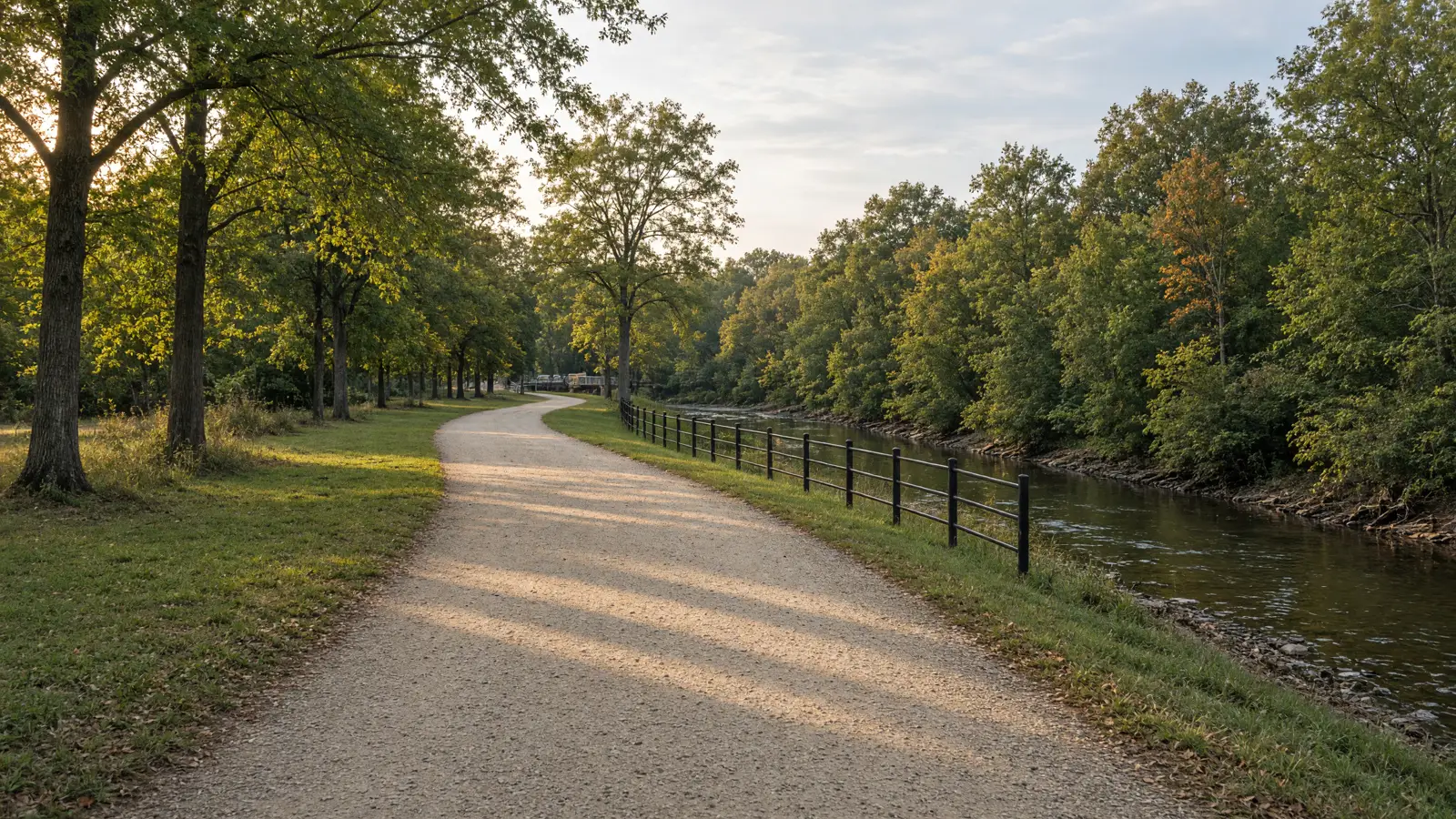
Things To Do on an eBike in Guilford County, NC
Guilford County has a mix of paved greenways, a national park tour road and unpaved county trails. For an eBike, the paved options are simple. The Downtown Greenway, the Bicentennial Greenway and the Guilford Courthouse Tour Road all suit a pedal-assist ride. The unpaved Watershed Trails need more caution.
The rules differ by manager. The National Park Service and the Downtown Greenway state their e-bike rules in writing. The county and city trail pages do not, and the county bans motorized vehicles on trails without naming e-bikes. This guide gives each route's manager, length, surface and rule, and says plainly where a detail is not published.
Where to ride in Guilford County
The routes sit in and around Greensboro. The Downtown Greenway loops through the city center. The Bicentennial Greenway starts at Gibson Park. The Atlantic & Yadkin Greenway starts at Bur-Mil Park, where the Nathanael Greene and Owl's Roost trails also meet it. The Guilford Courthouse Tour Road is inside the national military park, with a connector to Country Park at Stop 4.
The Bicentennial Greenway is longest at 14.5 miles, with asphalt and gravel. The Atlantic & Yadkin Greenway is about 7.74 miles per TrailLink, or 7 1/5 miles per ABC45, on asphalt, concrete and crushed stone. The Downtown Greenway has 3 paved miles open. The Tour Road is 2.25 paved miles. Only the Downtown Greenway and the Tour Road state e-bike rules. The Watershed Trails are unpaved and have no stated length.
eBike shop hubs
Find a shop near your ride. Greensboro has 15 listings and High Point has 3, and each city page lists them in full.
Other local service contacts
No rental listings show up for Guilford County right now, so these shops are the local contacts for service, parts and test rides. Call Exalted E-Bikes or Bicycle Toy and Hobby Sales first to ask whether they work on your motor system and battery.

Named eBike routes and access checks
1. Downtown Greenway, paved loop with a clear eBike rule
The Downtown Greenway is a paved shared multi-use path around central Greensboro. It is managed by the City of Greensboro and Action Greensboro. It is planned as a 4-mile walking and biking trail, and 3 miles are open, covering the north, east and south sections. The west side final mile is not open. The city page said it was planned to go under construction in 2023, so check for the current status. The path is open 24/7. The greenway FAQ says e-bikes, e-scooters and motorized wheelchairs are allowed. Other motorized vehicles are not permitted. No speed limit is stated. It is the best first ride for a new eBike owner.
Distance: 3 miles open of a planned 4-mile loop, per the Downtown Greenway FAQ; start: Several access points; check the manager map; surface: Paved shared multi-use path.
eBike access: E-bikes, e-scooters and motorized wheelchairs are allowed. Other motorized vehicles are not permitted. No speed limit is stated. Etiquette and planning: Slow down around walkers and at crossings. No speed limit is posted in the published rules, so set your own pace and use the lowest assist near crowds. Managing source: Downtown Greenway, FAQ.
2. Bicentennial Greenway, the long ride from Gibson Park
The Bicentennial Greenway is the longest route in this guide. Guilford County lists it at 14.5 miles, and it is managed by Guilford County and the City of Greensboro. The trailhead is at Gibson Park. The county says bicycles are allowed and encouraged, and the greenway is open daily from sunrise to sunset. Sources differ slightly on the surface. The county says asphalt and gravel. TrailLink says asphalt, concrete and gravel. The county page has no e-bike rule, so the North Carolina default applies. The county's general park rules ban motorized vehicles on bike trails without naming e-bikes, so ask the parks office if you are unsure.
Distance: 14.5 miles, per Guilford County Parks and Recreation; start: Gibson Park trailhead; surface: Asphalt and gravel, per Guilford County; TrailLink lists asphalt, concrete and gravel.
eBike access: Bicycles are allowed and encouraged. No e-bike rule is published on the county page, so the state default applies. Open daily, sunrise to sunset. Etiquette and planning: Plan to finish before sunset, since the greenway closes then. Carry a charger or a spare battery for the long distance, and watch for gravel sections. Managing source: Guilford County Parks and Recreation, Trails.
3. Guilford Courthouse Tour Road, a one-way national park loop
The Tour Road is inside Guilford Courthouse National Military Park, managed by the National Park Service. It is a paved, one-way road of 2.25 miles. A connector reaches Country Park at Stop 4. The Park Service allows e-bikes on roads, parking areas and trails that are open to traditional bicycles. The speed limit is 20 mph. Biking is allowed only on the Tour Road. Pedestrian paths and Historic New Garden Road are not open to bikes. It is short, so it works well as a warm-up or a ride with a mixed-ability group.
Distance: 2.25 miles, one way, per the National Park Service; start: The park trailhead, with a connector to Country Park at Stop 4; surface: Paved Tour Road.
eBike access: E-bikes are allowed on roads, parking areas and trails open to traditional bicycles. The speed limit is 20 mph. Do not ride on pedestrian paths. Etiquette and planning: Ride one way only, with traffic. Keep under 20 mph, watch for cars and walkers, and stay off the pedestrian paths. Managing source: National Park Service, Guilford Courthouse bike page.
4. Atlantic & Yadkin Greenway: Bur-Mil Park and a closed trestle
The Atlantic & Yadkin Greenway is listed by both the City of Greensboro and Guilford County, but neither page names a managing agency, and the trailhead is at Bur-Mil Park. The route runs from Summerfield Road to Markland Drive, with the old Battleground Rail-Trail and Lake Brandt Greenway now part of it. Length is a conflict, with 7.74 miles and 7 1/5 miles both reported. The listed materials include asphalt, concrete and crushed stone, while the northernmost trestle bridge between Strawberry Road and Bur-Mil Park is closed with no paved detour. Weaver Bridge remains open, and no e-bike rule is published, so the state default applies.
Distance: About 7.74 miles per TrailLink, or 7 1/5 miles per ABC45; start: Bur-Mil Park trailhead; surface: Asphalt, concrete and crushed stone, per TrailLink.
eBike access: No e-bike rule is published by the county or city, so the state default applies. Check posted signs for closures. Etiquette and planning: The northern trestle bridge is closed with no paved detour. Plan a turnaround point, and check the city page before you go. Managing source: City of Greensboro, Trails and Greenways.
5. Nathanael Greene Trail, unpaved Watershed Trail near Bur-Mil
The Nathanael Greene Trail is one of the Watershed Trails listed by Guilford County. It is unpaved, and its length is not published. It intersects the Atlantic & Yadkin Greenway near Bur-Mil Park. The managing agency is not stated. County park rules prohibit operating motorized vehicles on hike trails, bike trails, equestrian trails and exercise trails. They do not mention e-bikes by name. That leaves a gray area, and you should not assume an e-bike is welcome here. Ask the county parks office or look for posted signs at the access point. A regular pedal bike is the safer choice on this trail.
Distance: Nathanael Greene Trail: length is not published by the county; start: Nathanael Greene Trail: near Bur-Mil Park, where it meets the Atlantic & Yadkin Greenway; surface: Unpaved.
eBike access: County rules ban motorized vehicles on trails and do not mention e-bikes. No e-bike rule is published, so confirm with the county before riding. Etiquette and planning: Do not ride if signs say no motorized vehicles. Yield to hikers, slow down on soft ground, and stay on the marked trail. Managing source: Guilford County Parks and Recreation, Trails.
6. Owl's Roost Trail, unpaved Watershed Trail with the same open question
Owl's Roost Trail is another Watershed Trail listed by Guilford County. It is unpaved, and its length is not published. Like the Nathanael Greene Trail, it intersects the Atlantic & Yadkin Greenway near Bur-Mil Park. The managing agency is not stated. The county's Uniform Park and Open Space Rules prohibit motorized vehicles on hike, bike, equestrian and exercise trails. They also bar mopeds, scooters and other self-propelled vehicles. E-bikes are not mentioned by name. Bicycles are allowed only on designated paths, trails and public roadways. Treat this as a trail to ask about first, and follow any posted sign.
Distance: Owl's Roost Trail: length is not published by the county; start: Owl's Roost Trail: near Bur-Mil Park, where it meets the Atlantic & Yadkin Greenway; surface: Unpaved.
eBike access: County rules ban motorized vehicles on trails without naming e-bikes. No e-bike rule is published, so confirm with the county before riding. Etiquette and planning: Follow posted signs, yield to walkers, and keep your assist low. If a staff member or sign says no, walk the bike out. Managing source: Guilford County Parks and Recreation, Uniform Park and Open Space Rules.
Planning a Guilford County ride
Charging locations are not published for these routes, so charge at home or at a shop before you ride. The Bicentennial Greenway is 14.5 miles, so a long out-and-back may need a spare battery. Crowd levels are not published. Expect more people on the Downtown Greenway, which sits in the city center and is open 24/7. Park hours matter: the Bicentennial Greenway closes at sunset.
Check closures first, because the northernmost Atlantic & Yadkin trestle bridge, between Strawberry Road and Bur-Mil Park, is closed with no paved detour. The City of Greensboro anticipates construction in fall 2026. No transit or ferry options are published for these routes. Use the posted signs and the manager map at each trailhead for the latest detours.
Half-day and full-day eBike plans
Half day: Ride the Downtown Greenway, which has 3 paved miles open and an e-bike rule in writing. Then drive to Guilford Courthouse National Military Park for the 2.25-mile one-way Tour Road. Keep to 20 mph there. This pairing is all paved and needs no special planning beyond a charged battery.
Full day: Start at Gibson Park and ride the Bicentennial Greenway, which is 14.5 miles by the county's count. Check the sunset closing time before you leave. If you have energy left, add the Tour Road. Carry a spare battery and water. Skip the unpaved Watershed Trails unless the county confirms e-bikes are welcome.
Rainy-season backup: Choose a paved route after rain. The Downtown Greenway and the Tour Road are both paved, so they handle wet weather better than the gravel sections on the Bicentennial Greenway or the unpaved Watershed Trails. Slow down on wet pavement and leaves, and check closures before you leave home.
What not to ride in Guilford County
Pedestrian paths at Guilford Courthouse: The National Park Service allows biking only on the Tour Road. Pedestrian paths and Historic New Garden Road are off limits to bikes. Stay on the one-way road, and keep to 20 mph.
Watershed Trails without confirmation: County rules prohibit motorized vehicles on hike, bike, equestrian and exercise trails and do not name e-bikes. The Nathanael Greene and Owl's Roost trails are unpaved. Do not ride an e-bike there unless the county or a sign says it is fine.
The closed Atlantic & Yadkin trestle: The northernmost trestle bridge between Strawberry Road and Bur-Mil Park is closed. There is no paved detour. Do not cross it or go around it on unmarked ground.
Park roads with motor traffic rules: County rules limit motorized vehicles to paved roadways and designated parking. Mopeds, scooters, dirt bikes and ATVs are prohibited. A bike that is faster than 20 mph or over 750 watts is legally a moped under state law.
When to ride Guilford County
Seasons, heat and crowds are not published for these routes, so use general judgment. Spring and fall are usually comfortable for riding in this part of North Carolina, and summer afternoons can be hot, so ride early and carry water. Hours matter, and the Bicentennial Greenway is open sunrise to sunset, and the Downtown Greenway is open 24/7. The Downtown Greenway is in the city center, so expect more walkers there at lunch and on weekends.
North Carolina eBike laws and route permission
North Carolina does not use the three-class system for eBikes. Under G.S. 20-4.01, an "electric assisted bicycle" has two or three wheels, a saddle, and fully operable pedals. It also has an electric motor of no more than 750 watts. Its top speed on level ground under motor power alone cannot be greater than 20 mph. A bike that fits that definition is treated as a bicycle. Anything faster or stronger falls outside it, so Class 1, 2 and 3 labels do not carry legal weight in state law.
Under G.S. 20-4.01(49), bicycles and electric assisted bicycles are vehicles. Riders on a highway follow the rules for drivers where they apply. State law does not address eBikes on trails or multi-use paths. Local ordinances govern greenways, and the administrative code governs state parks and forests. So the city, county, or park manager decides where you can ride off the road. Sidewalk riding is set locally, so check city rules. Senate Bill 576 (2025) would add Classes 1-3 and local regulation authority. It was not enacted as of our latest search, so it is still pending.
It is not clear whether the under-16 bicycle helmet law in G.S. 20-171.9 covers e-bikes, since it defines a bicycle as human-powered. Starting December 1, 2026, Class 3 riders under 18 must wear a helmet. See what changes on Dec. 1. No license or registration is required for an electric assisted bicycle. The UNC School of Government post on eBike law explains that an eBike over 750 watts, or one able to exceed 20 mph, is legally a moped. That means an operator aged 16 or older, DMV registration, liability insurance, and a helmet on highways. For more detail, read our guide to North Carolina eBike laws.
Before you plan a trail ride, find out who runs the trail. The state does not set one rule for eBikes on trails or multi-use paths. A city or county ordinance usually governs a greenway. State parks and forests fall under the administrative code. A path that allows eBikes in one town may not allow them in the next. Check the posted rules or call the managing office before you go, and do not assume a road rule carries over to a path.
Managers may set their own limits, so check the posted rules for each trail. Because state law has no classes, a trail rule written around Class 1, 2 or 3 would not match the statute's single definition of 750 watts and 20 mph. If Senate Bill 576 passes, it would give local authorities clear power to regulate. Keep your bike within the 20 mph, 750 watt definition. A faster or stronger bike is legally a moped and is unlikely to be welcome on shared paths.
North Carolina does not use the three-class system. State law defines an electric assisted bicycle by pedals, a motor of no more than 750 watts and a motor-only top speed of 20 mph. State law does not address trails, so local rules govern. Guilford County's park rules ban motorized vehicles on trails and do not mention e-bikes. The Downtown Greenway and the National Park Service state e-bike rules in writing.
Sources disagree on one point. The Atlantic & Yadkin Greenway is 7.74 miles per TrailLink and 7 1/5 miles per ABC45. The Bicentennial Greenway surface is asphalt and gravel per the county, and asphalt, concrete and gravel per TrailLink. No Greensboro or Guilford County sidewalk e-bike rule was found. Check posted signs on sidewalks. See North Carolina eBike laws for state rules.
Some changes are scheduled, though none is e-bike specific. The A&Y Greenway Extension schedule lists design completion in winter 2026, NCDOT design approval and right-of-way acquisition in spring 2027, a construction ad in summer 2027, construction start in winter 2028 and completion in summer 2029. The trestle bridge north of Bur-Mil is anticipated to be rebuilt starting fall 2026 and finish in fall 2027. Senate Bill 576 (2025) would add Classes 1-3 but has not been enacted.
Frequently asked questions
Which Guilford County route is best for a first eBike ride?
The Downtown Greenway is a good start. It is paved, shared and open 24/7, and its FAQ says e-bikes are allowed, and three miles are open. The Tour Road at Guilford Courthouse is also easy: 2.25 paved miles, one way, with a 20 mph limit.
How long is the Bicentennial Greenway?
Guilford County lists it at 14.5 miles. The trailhead is at Gibson Park. It is open daily from sunrise to sunset. The county says the surface is asphalt and gravel, while TrailLink lists asphalt, concrete and gravel.
How long is the Atlantic & Yadkin Greenway?
The reported distances differ, because TrailLink says 7.74 miles, and ABC45 says 7 1/5 miles. TrailLink lists endpoints at Summerfield Road and Markland Drive, and the trailhead is at Bur-Mil Park. Check the city page for current closures.
Is part of the Atlantic & Yadkin Greenway closed?
Yes, the northernmost trestle bridge between Strawberry Road and Bur-Mil Park is closed, and there is no paved detour. The City of Greensboro anticipates construction in fall 2026 and completion in fall 2027, and Weaver Bridge remains open.
What is the speed limit at Guilford Courthouse?
The speed limit is 20 mph on the Tour Road. The road is one way and paved, and it is 2.25 miles long. E-bikes are allowed on roads, parking areas and trails open to traditional bicycles. Pedestrian paths are not open to bikes.
Do I need a license for an eBike in North Carolina?
Not for an electric assisted bicycle. It needs pedals, a motor of no more than 750 watts and a top motor-only speed of 20 mph. A faster or stronger e-bike is legally a moped, which needs a rider 16 or older, DMV registration, insurance and a helmet.
Do kids need helmets?
Yes, riders under 16 must wear a helmet on public roads, paths and rights-of-way under North Carolina's bicycle helmet rule. That applies on the greenways in Guilford County as well as on streets.
Can I ride an eBike on the Watershed Trails?
It is unclear, and the Nathanael Greene and Owl's Roost trails are unpaved county trails. County rules ban motorized vehicles on trails and do not mention e-bikes by name. Ask the county parks office or follow posted signs before riding.
All eBike shops in Guilford County
Need a bike, a battery or a repair before you ride? Browse all Guilford County eBike shops, grouped by city.