North Carolina's E-Bike Law Changes Dec. 1: Class 3 Is No Longer a Moped
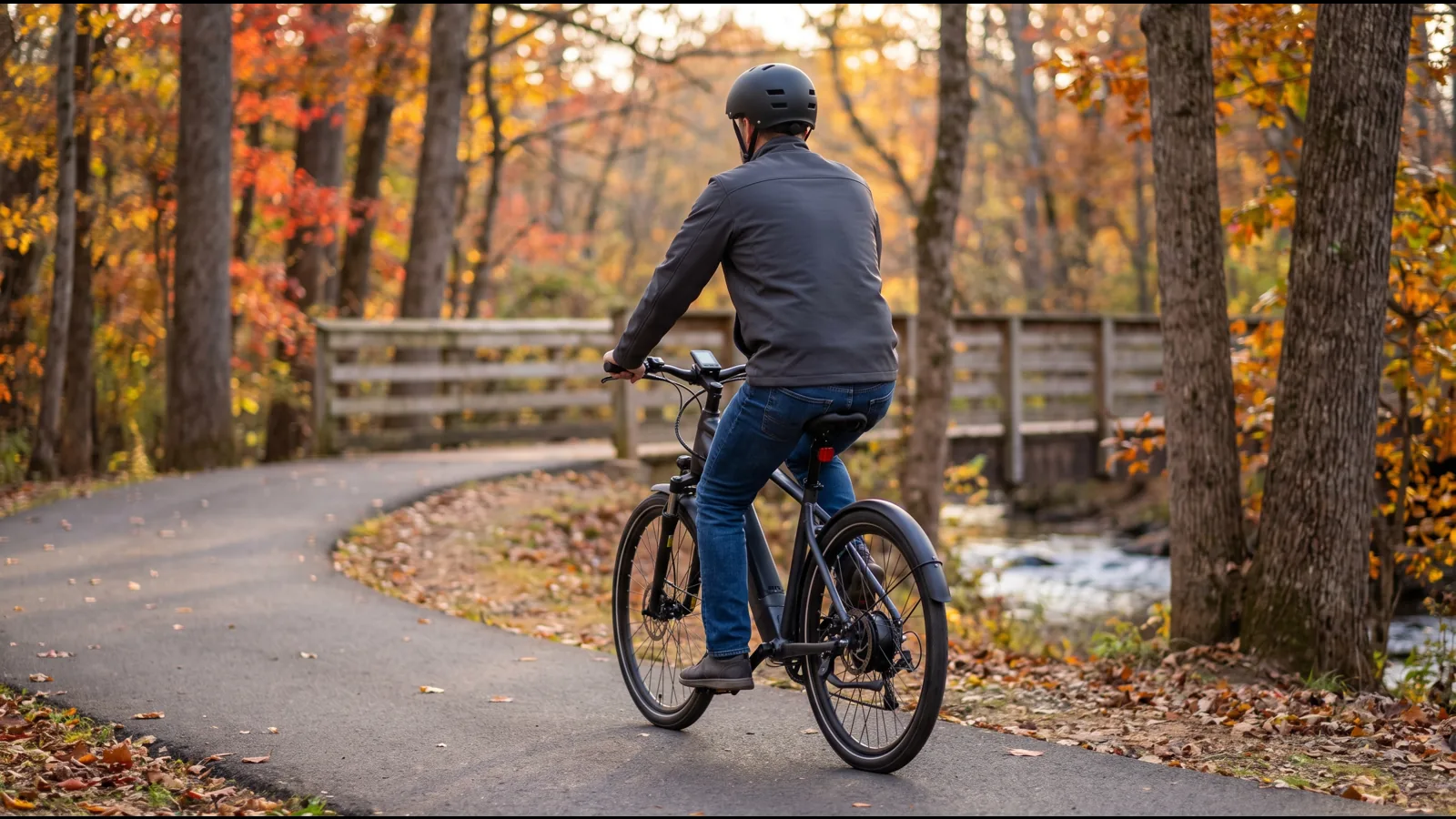
What the Dec. 1 change means depends on your bike's class and your town.
Short answer: Until November 30, 2026, a pedal-assist bike that reaches 28 mph is a moped in North Carolina. The rider must be 16 or older, the bike needs DMV registration and liability insurance, and the rider needs a helmet. On December 1, S.L. 2026-46 makes it a Class 3 e-bike, and those moped rules stop applying. The new statewide rule is a helmet for anyone under 18 on a Class 3. Towns and counties can add their own path and sidewalk rules.
This post is general information, not legal advice. Check S.L. 2026-46 and your city or county ordinances for your situation.
Why shops don't sell Class 3 out of the box
Belal Elrahal, co-author of a UNC School of Government post, test-rode e-bikes at local shops. Retailers had divided their inventory into Class 1, 2 and 3 but did not sell Class 3 out of the box. They sold Class 2 bikes that could be adjusted in settings to Class 3 after the sale.
There is a reason for that. Until December, a Class 3 is a moped under G.S. 20-4.01(27)j.
The rules until November 30
Current G.S. 20-4.01(7a) defines an electric assisted bicycle as a two- or three-wheeled bike with a seat, fully operable pedals, a motor of no more than 750 watts and a top speed of 20 mph on a level surface powered solely by the motor. A faster bike, up to 30 mph, fits the moped definition, which allows an electric motor. A moped comes with these requirements:
- The operator must be at least 16 (G.S. 20-10.1).
- It must be registered with the DMV, with the same base fee and plate as a motorcycle and no title (G.S. 20-53.4).
- The owner must have liability insurance (G.S. 20-309(a)).
- The operator and every passenger must wear a helmet that complies with FMVSS 218 (G.S. 20-140.4). A violation is an infraction with a $25.50 penalty plus court costs and no license points.
Above 30 mph, North Carolina treats a bike as a motorcycle. The School of Government says very few, if any, local shops sell those, though online retailers do.
What changes on December 1
The legislature ratified House Bill 1094 on July 2, the governor signed it July 7, and it was chaptered as S.L. 2026-46 on July 8 (bill history). Section 19 takes effect December 1, 2026 and applies to offenses committed on or after that date.
The new G.S. 20-4.01(7a) keeps the pedals, the seat and the 750-watt cap, and sorts e-bikes into three classes:
- Class 1: the motor assists only while you pedal and stops assisting at 20 mph.
- Class 2: the motor may propel the bike without pedaling and stops assisting at 20 mph.
- Class 3: the motor assists only while you pedal and stops assisting at 28 mph.
A Class 3 is no longer a moped, so under state law it needs no minimum age, registration or insurance (G.S. 20-10.1, 20-53.4 and 20-309(a) no longer reach it). Bikes over 750 watts, or that assist past 28 mph, fall outside the e-bike definition. The School of Government says those machines will generally be treated as motorcycles.
The helmet rule and the under-16 law
New G.S. 20-171.3(b) requires anyone under 18 who operates or rides as a passenger on a Class 3 to wear a helmet that meets federal safety standards. A violation on or after December 1 is an infraction under G.S. 20-176. An infraction under Article 3 carries a penalty of up to $100 unless a specific penalty is set (G.S. 20-176(b)).
Cities may require helmets for under-18 operators and passengers on Class 1 or Class 2 bikes (G.S. 160A-300.2). The state rule itself names only Class 3.
The Child Bicycle Safety Act (G.S. 20-171.9) makes it unlawful for a parent or guardian to knowingly let a child under 16 ride a bicycle on a public roadway or path without a helmet. Its definition of bicycle, in G.S. 20-171.8, is a human-powered vehicle designed to be pedaled. It does not mention e-bikes, so whether it reaches them is unclear. The Class 3 rule is the clear one. A helmet is still a sensible purchase for any e-bike rider, whatever the class.
Where you can ride
New G.S. 20-171.3(a) permits e-bikes on all roadways, bicycle lanes and multiuse paths. The exceptions are local rules under G.S. 160A-300, 160A-300.2 and 153A-245.1, and State parks, historic sites and other properties regulated by the Department of Natural and Cultural Resources.
Under G.S. 160A-300.2, a city may regulate e-bikes on any multiuse path or sidewalk within its limits, including restricting a class and setting speed limits. Under G.S. 153A-245.1, a county may do the same. The School of Government says that covers county-controlled places such as parks and greenways, not state-maintained roads. Municipalities presumably keep power over streets under G.S. 160A-300.
Section 19(e) directs NCDOT to develop educational materials on e-bike use and safety. The law sets no deadline.
What local governments are doing
This is the status as of October 19, 2026. Read the current ordinance before you ride.
- Wake Forest: commissioners voted Jan. 20 to allow motorized scooters, e-bikes and electric assisted bicycles on shared streets, greenways, parks, multi-use paths and bicycle lanes, but not sidewalks. Anyone under 16 must wear a bicycle helmet, and the limit is 10 mph on a greenway, in a park or on a multi-use path (town release).
- Charlotte: after CMPD reported a 77% year-over-year rise in e-bike crashes, the Safety Committee voted Sept. 8 to send proposed rules to the full council (WCCB). Full council agendas through Oct. 19 list no e-bike item, so no vote yet.
- Surf City: an August staff draft would set a 20 mph path cap and a 10 mph bridge zone (Topsail Guide). The town held a public workshop Sept. 28, and its Oct. 15 work session agenda listed e-bike and multi-use path rules for discussion, with no vote requested. We found no adopted ordinance as of Oct. 19.
- Dare County: county parks banned e-bikes earlier this spring, and riders must walk them through (Island Free Press).
- Raleigh, Cary and the Triangle: check the town's current greenway rules before riding. Cary police reportedly responded to more than 219 e-bike calls in the 16 months starting January 2025, according to the School of Government.
Buyer checklist for holiday shoppers
At a Wilmington traffic safety summit, state leaders told parents considering an e-bike to research classifications, check local speed laws and buy a certified helmet. Here is a longer list.
- Find the class, top assisted speed and motor wattage on the bike's label. Our motor label guide shows where to look.
- Ask whether the class can be changed in settings, and which class the bike is set to at purchase.
- Pass on anything over 750 watts or assisting past 28 mph. It falls outside the e-bike definition.
- Know the date. A 28 mph bike ridden before December 1 is a moped, with the age, registration, insurance and helmet rules above.
- Buy a certified helmet. It is required for under-18 riders on a Class 3 and wise on every class.
- Look up your town's rules for greenways, sidewalks and parks.
- Call your insurance agent. Topsail Guide reports that state law requires no liability insurance on an e-bike, and standard homeowners policies commonly exclude liability for an owned self-propelled vehicle used away from home.
Find a local shop
A good shop can tell you a bike's class and whether it can be changed in settings. According to their own websites, each of these sells e-bikes and offers repair service:
- Trek Bicycle Cary, 1377 NW Maynard Rd, Cary.
- Oak City Cycling, 707 N Person St, Raleigh.
- Trek Bicycle Store of Charlotte, 12194 Johnston Rd, Charlotte, which also lists e-bike demos.
To look further, browse e-bike shops in Raleigh, Cary, Wake County, Charlotte and Wilmington, or see all North Carolina e-bike shops. Our guide to the best e-bike shops in Raleigh and the North Carolina e-bike laws guide have more.
Sources: S.L. 2026-46; H1094 bill history; UNC School of Government, Coates' Canons, Sept. 2, 2026; WCCB Charlotte; Topsail Guide; Town of Wake Forest; Island Free Press; WECT.
Frequently Asked Questions
Does a Class 3 e-bike need registration or insurance in North Carolina after December 1?
Not under state law. After December 1, 2026 a Class 3 is no longer a moped, so the moped rules for minimum age, DMV registration and liability insurance no longer apply to it. Until then, a 28 mph bike is a moped. Your town may have its own rules, and homeowners policies commonly exclude liability for a self-propelled vehicle used away from home, so ask your insurance agent.
Do kids have to wear helmets on e-bikes in North Carolina?
Starting December 1, G.S. 20-171.3(b) requires anyone under 18 riding or operating a Class 3 to wear a helmet that meets federal safety standards. Cities may require helmets for under-18 riders on Class 1 and Class 2. The under-16 Child Bicycle Safety Act defines a bicycle as human-powered and does not mention e-bikes, so it is unclear whether it applies. A helmet is a good idea either way.
Can my town restrict e-bikes on greenways and sidewalks?
Yes. Under G.S. 160A-300.2, a city may regulate e-bikes on any multiuse path or sidewalk within its limits, including restricting a class and setting speed limits. Under G.S. 153A-245.1, a county may do the same in county-controlled places such as parks and greenways, but not on state-maintained roads. Check your town's current rules before you ride.
Shopping in North Carolina?
Find a local shop that can tell you the class of the exact bike and how it is set up.
North Carolina eBike Shops → NC eBike Laws →