eBike Laws in North Carolina (2026)
The American Tobacco Trail anchors the Triangle, greenways lace Charlotte and Asheville, and the Outer Banks offer flat ocean-breeze miles.
eBike Rules in North Carolina
Until November 30, 2026: North Carolina law does not sort e-bikes into classes. An "electric assisted bicycle" has fully operable pedals, a motor of 750 watts or less, and a top motor-powered speed of 20 mph on level ground (G.S. 20-4.01(7a)). State law leaves these bikes out of the definition of "motor vehicle" (G.S. 20-4.01(23)), so no driver's license, registration or insurance is needed. A bike whose motor can push it faster than 20 mph, up to 30 mph, is legally a moped (G.S. 20-4.01(27)j.). That includes a 28 mph bike sold as "Class 3." A moped rider must be at least 16 (G.S. 20-10.1). The moped must be registered with the DMV (G.S. 20-53.4) and insured (G.S. 20-309(a)). The rider and any passenger must wear a helmet (G.S. 20-140.4). Over 30 mph, the bike is a motorcycle.
Starting December 1, 2026: Session Law 2026-46 adopts Class 1 (pedal assist to 20 mph), Class 2 (throttle to 20 mph) and Class 3 (pedal assist to 28 mph), all with a 750-watt motor cap. A Class 3 is no longer a moped, so the moped age, registration and insurance rules stop applying to it. Anyone under 18 riding or carried as a passenger on a Class 3 must wear a helmet that meets federal safety standards (new G.S. 20-171.3(b)). A violation is an infraction (G.S. 20-176). Cities and counties may restrict classes and set speed limits on multiuse paths and sidewalks. They may also require helmets for under-18 riders on Class 1 and Class 2 (new G.S. 160A-300.2 and 153A-245.1).
Kids under 16: The Child Bicycle Safety Act (G.S. 20-171.9) makes it unlawful for a parent or guardian to knowingly let a child under 16 ride a bicycle without a helmet. Its definition of bicycle (G.S. 20-171.8) is human-powered and does not mention e-bikes, so it is unclear whether the Act covers them.
Correction, October 19, 2026: An earlier version of this guide said North Carolina already used three classes, required no registration for any class, and had an under-16 helmet rule for e-bikes. That was not accurate before December 1. See what changes on Dec. 1.
Laws change session to session. Verify current North Carolina rules on PeopleForBikes →
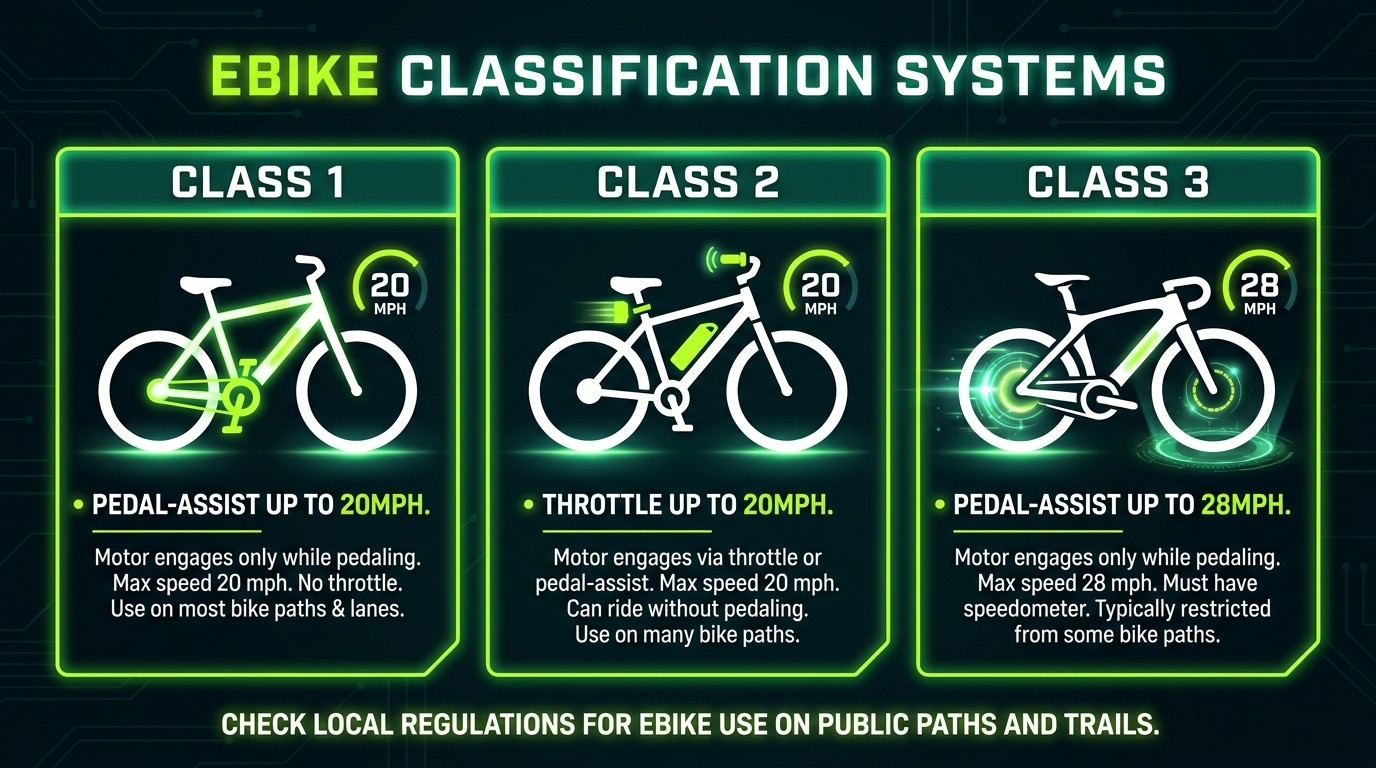
Nearly every state that regulates eBikes by class uses the same three-tier system, first adopted by California in 2015 and now used in most of the country. Class 1 eBikes only assist while you pedal, cutting off at 20 mph. Class 2 eBikes add a throttle that can move the bike without pedaling, also capped at 20 mph. Class 3 eBikes are pedal-assist only but the motor keeps helping up to 28 mph, and many states require these bikes to carry a speedometer. Knowing your bike's class matters because it determines which trails and paths you can legally ride: Class 3 bikes are sometimes barred from multi-use paths that allow Class 1 and 2.
Best Time to Ride in North Carolina
March through November; mountain summers stay cool, the coast rides nearly year-round.
Terrain: Piedmont rollers, Blue Ridge climbs, dead-flat coast.

Riding country in North Carolina.
Top eBike Trails in North Carolina
eBike Shops & Dealers in North Carolina
eBikeListings tracks 349 verified eBike shops, dealers and repair centers across 135 cities and 67 counties in North Carolina, most concentrated in Asheville, Charlotte, Raleigh. Every listing includes hours, ratings, and contact info pulled directly from Google Business Profiles.
Frequently Asked Questions
Do you need a license to ride an eBike in North Carolina?
Not for an electric assisted bicycle that tops out at 20 mph under motor power. Until November 30, 2026, a bike whose motor assists past 20 mph (including a 28 mph "Class 3") is a moped. The rider must be 16 or older, and the bike needs DMV registration, liability insurance and helmets for the rider and any passenger. From December 1, 2026, Class 1, 2 and 3 e-bikes need no license, registration or insurance under state law. Riders and passengers under 18 on a Class 3 must wear a helmet.
What is the speed limit for eBikes in North Carolina?
Until November 30, 2026, an electric assisted bicycle's motor can power it to no more than 20 mph. Faster bikes, up to 30 mph, are mopeds. From December 1, 2026, Class 1 and Class 2 motors stop assisting at 20 mph, and Class 3 motors stop assisting at 28 mph. Cities and counties can also set e-bike speed limits on multiuse paths and sidewalks.
Where can I ride an eBike in North Carolina?
Popular eBike destinations in North Carolina include the American Tobacco Trail, Asheville’s French Broad greenways, the Outer Banks beach roads.
Where can I buy or repair an eBike in North Carolina?
eBikeListings tracks 349 verified eBike shops, dealers and repair centers across 135 cities and 67 counties in North Carolina, with the largest concentrations in Asheville, Charlotte, Raleigh.
Find eBike Shops in North Carolina
Browse verified dealers, repair centers, and rental shops across North Carolina.
Browse North Carolina Listings →Also see: eBike Laws in All 50 States