The Bike Industry Wants the Feds to Stop Calling E-Motos "E-Bikes." Here's What That Means for Buyers
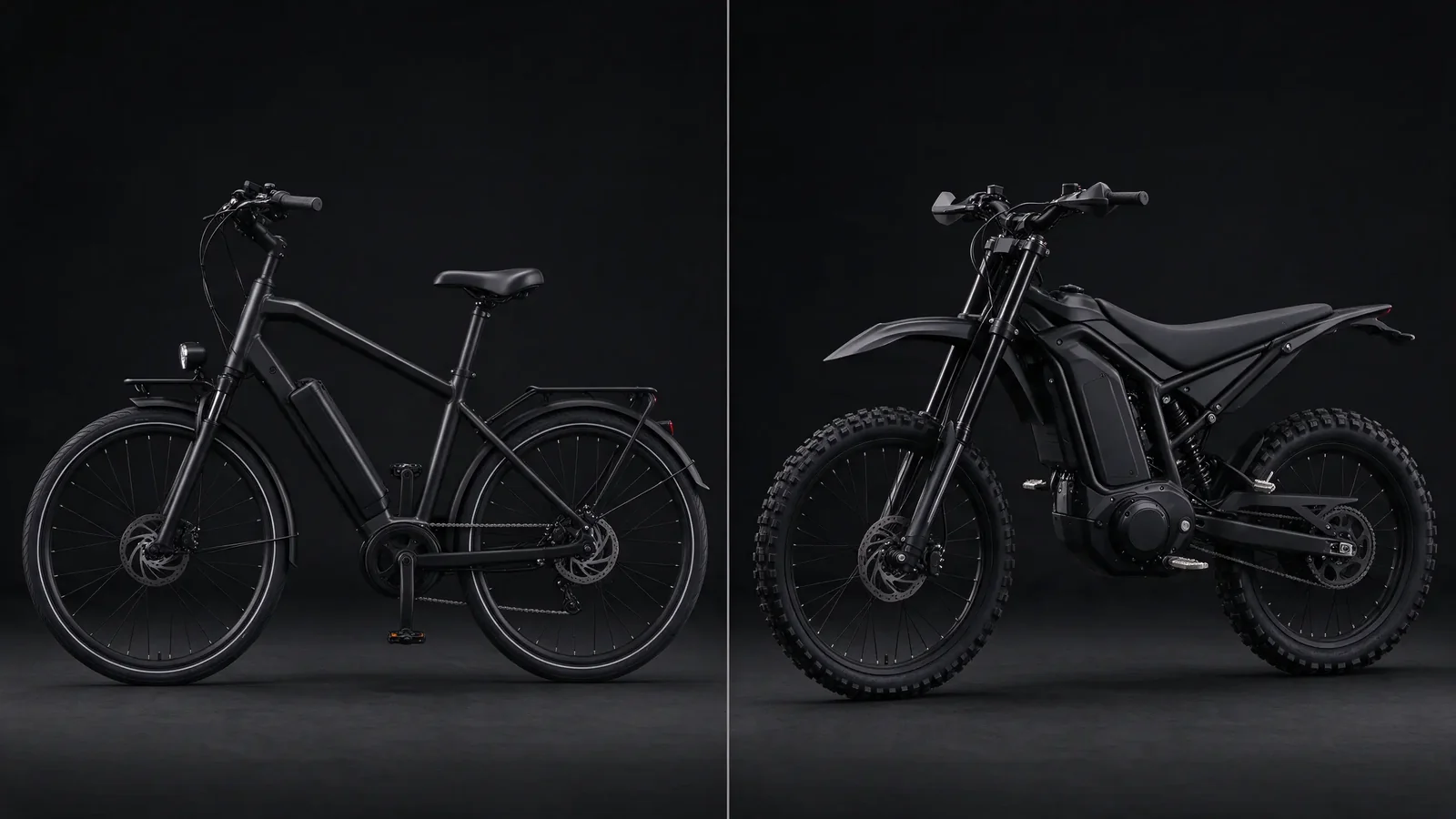
Left, a pedal e-bike. Right, a pedal-less electric dirt bike. Illustration, no real brands.
Short answer: At an Oct. 21, 2026 public hearing, the bicycle industry's main trade group asked the Consumer Product Safety Commission to treat e-motos as their own category, separate from low-speed electric bicycles, in its proposed lithium-ion battery rule. Nothing has changed yet. It's testimony on a proposed rule. As of Nov. 11 the CPSC hadn't published a final rule or announced a date for one.
Jump to: What was asked · The proposed rule · Why it matters · E-bike vs e-moto table · Check your bike · What happens next · FAQ
"E-bike" has become a catch-all. High-powered electric dirt bikes that can reach motorcycle speeds get called e-bikes, even though they have little in common with the 20 mph pedal-assist bikes most people ride, Electrek's Micah Toll wrote on Nov. 9. The legal question isn't what a seller calls a machine. It's whether the machine meets a legal definition of an electric bicycle.
That confusion has real consequences for riders, parents and shops. Orange County prosecutors are charging parents over their kids' e-motos, and states keep writing their own definitions. Now the bike industry wants federal regulators to fix the vocabulary at the source.
What PeopleForBikes asked for
PeopleForBikes general counsel Matt Moore testified at the CPSC's Oct. 21 virtual hearing and filed written comments. According to PeopleForBikes, he asked the Commission to:
- Use the definition already in federal law. The proposed rule uses a generic "eBike" definition. PeopleForBikes wants it to use the statutory term "low-speed electric bicycle" so it's clear which vehicles are covered.
- Define e-motos separately. The group describes e-motos as machines with powerful motors "capable of high speeds up to 60 mph." Some have no working pedals and are sold as off-road electric dirt bikes.
- Set electrical safety standards for off-road e-motos. The CPSC has jurisdiction over off-road e-motos, but electric cycles without pedals fall outside UL 2849-20, the electrical-system standard for e-bikes.
- Don't treat conversion kits as legitimate consumer products. PeopleForBikes says kits let people turn a regular bicycle into a faster motorized vehicle that can exceed the frame's design strength and the limits of its parts.
The group also called on the CPSC and the National Highway Traffic Safety Administration to work together against e-motos that avoid required safety standards.
"E-bikes and e-motos are fundamentally different products, and federal safety regulations need to reflect that distinction," Moore said, as quoted by Bicycle Retailer. "When high-powered electric dirt bikes are marketed as e-bikes, it creates confusion for consumers and puts the credibility of legitimate e-bikes at risk."
Consumer Reports testified the same day. It wants the CPSC to finalize a strong rule quickly, and it supports the agency's proposed extra tests, including post-discharge and reverse-polarity tests. It also wants warning labels on conversion kits about frame stress and brake failure. On the road side, CR says any throttle-driven on-road vehicle that can go faster than 20 mph on motor power alone should be classified as a motor vehicle under NHTSA.
Others who testified included the National Bicycle Dealers Association, UL Solutions, UL Standards & Engagement and the International Association of Fire Chiefs, Bicycle Retailer reported.
The rule they were testifying on
The CPSC published its proposed rule (91 FR 38162) on June 24, 2026. It would set a mandatory safety standard for lithium-ion batteries and electrical systems in micromobility products: e-bikes, e-scooters, self-balancing scooters and similar devices, plus aftermarket batteries, chargers and components sold in e-bike conversion kits. It would adopt existing UL standards, including UL 2849 for e-bike electrical systems, with added CPSC requirements. We covered the battery side before the hearing.
The proposal defines an eBike as a bicycle with functional pedals, propelled by an electric motor powered by a rechargeable lithium-ion battery, with or without a throttle. It sets no speed or wattage limit. That's the "generic" definition PeopleForBikes objected to.
Written comments closed Aug. 24. The CPSC announced the Oct. 21 hearing in a hearing notice (91 FR 63208). If the rule is finalized as proposed, it would take effect 180 days after the final rule is published and apply to products made after that date.
PeopleForBikes said it supports a stronger battery standard, but it urged the agency to gather more supporting data and adopt the UL standards without modification.
Why this matters if you ride or buy
Crash numbers. Toll argued in Electrek that many crash figures reported as "e-bike" crashes actually involve e-motos. When a 50 to 60 mph electric dirt bike gets counted with a 20 to 28 mph commuter bike, the commuter bike looks more dangerous than it is. The 760% ER-visit study had the same blind spot: emergency department records usually don't separate the two.
Laws that catch everyone. New Jersey's registration and license law, in effect since July 2026, covers everyday pedal-assist bikes as well as faster machines. Bicycle Retailer reported that the law has caused dozens of New Jersey bike shops to close, citing the National Bicycle Dealers Association and a consulting group. We haven't independently verified that count. A bill to exempt Class 1 and Class 2 bikes, S4830, is in committee. Hawaii took a different route and wrote its own e-moto definition into state law.
What you're actually buying. Online listings use "e-bike" for almost anything with two wheels and a battery. A clear federal e-moto category could make it harder to sell a 50 mph machine to a parent shopping for a kid's first e-bike.
E-bike vs e-moto at a glance
| Low-speed electric bicycle (federal) | E-moto / electric dirt bike | |
|---|---|---|
| Pedals | Fully operable pedals required | Some have none, and are sold as off-road dirt bikes |
| Motor | Less than 750 W (1 hp) | "Powerful motors," per PeopleForBikes; no federal cap |
| Top speed on motor alone | Less than 20 mph (170-lb rider, paved level surface) | Up to 60 mph, per PeopleForBikes; Electrek describes 50 to 60 mph machines |
| Federal agency | CPSC (consumer product) | CPSC for off-road products; NHTSA for on-road motor vehicles |
| Street use | State e-bike rules apply (Class 1/2/3 in most states) | Depends on state law; usually needs registration, a plate and a license, if it's street-legal at all |
The federal definition comes from 15 U.S.C. 2085, which makes low-speed electric bicycles consumer products under CPSC rules. It doesn't say where you can ride. The Class 1/2/3 system (assist to 20 mph for Classes 1 and 2, pedal assist to 28 mph for Class 3) is set state by state. See our e-bike laws by state hub for yours.
Check your bike before the rules catch up
- Find the label. Many states require e-bikes to carry a label with the class, top assisted speed and motor wattage. Here's where to look. California is moving to penalize fake e-bike labels.
- Look for UL 2849. It's the safety standard for an e-bike's electrical system, and the proposed federal rule builds on it.
- Do the throttle test. If it goes 20 mph or faster on the motor alone, it's outside the federal low-speed definition, whatever the listing calls it.
- Check the pedals. If they're missing or just for show, you're likely looking at an e-moto.
- Think twice about conversion kits for kids. PeopleForBikes and Consumer Reports both flagged kits, citing frame strength and brake risks.
- Buy from a shop that will tell you the class. Our guide to spotting a real e-bike shop covers what to ask. You can also browse local shops in the directory.
Worried about a battery you already own? Start with our charging safety guide and the Ridstar recall notes.
What happens next
The CPSC now has the written comments and the hearing record. It can finalize the battery rule, change it, or ask for more information. When we checked the Federal Register on Nov. 11, the June proposal and the October hearing notice were the latest documents in this rulemaking. No final rule had been published and no date for a vote had been announced.
Whether a final rule adds an e-moto definition is up to the Commission. Expect state lawmakers to keep writing their own definitions in the meantime.
FAQ
Did the federal government just ban e-motos?
No. PeopleForBikes asked the CPSC to define e-motos separately in a proposed battery safety rule. Nothing has been adopted.
What is the federal definition of an e-bike?
Federal law uses the term "low-speed electric bicycle": two or three wheels, fully operable pedals, a motor under 750 watts, and a top speed under 20 mph on motor power alone with a 170-pound rider on a paved level surface (15 U.S.C. 2085).
Is a Class 3 e-bike an e-moto?
No. Class 3 is a state e-bike category: the motor helps only while you pedal, up to 28 mph. The machines PeopleForBikes calls e-motos can reach up to 60 mph, and some have no working pedals.
When will the CPSC battery rule take effect?
There's no final rule yet. The proposal was published June 24, 2026, comments closed Aug. 24 and the hearing was Oct. 21. If it's finalized as proposed, it would take effect 180 days after the final rule is published.
Can I ride an e-moto in a bike lane?
Usually not. Most states treat a machine above e-bike limits as a motor vehicle or keep it off public roads unless it's registered. Check your state's rules before you ride.
Sources: PeopleForBikes, Nov. 4, 2026; Consumer Reports, Oct. 21, 2026; Federal Register, 91 FR 38162 (June 24, 2026) and 91 FR 63208 (Oct. 5, 2026), Docket CPSC-2025-0012; 15 U.S.C. 2085; Bicycle Retailer, Nov. 6, 2026; Electrek, Nov. 9, 2026. This is a summary of public testimony and a proposed federal rule, not legal advice.
Not sure what you're riding?
Check your state's e-bike rules, or ask a local shop to read the label.
E-Bike Laws by State → Find a Local Shop →