Charlotte Wants Helmets and Night Lights on E-Bikes. Here's What's Proposed
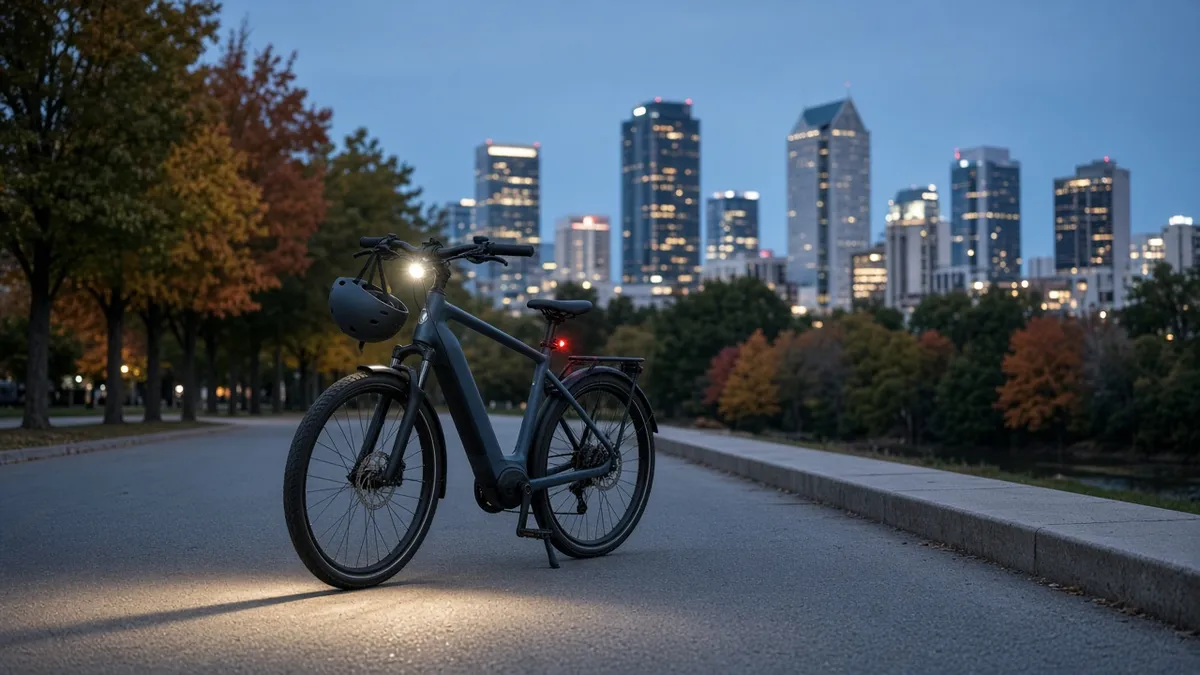
Charlotte's proposal would add helmet and night-light rules. Illustration.
Charlotte City Council got a preview of proposed e-bike rules on Monday, Oct. 26. City staff want helmets for young riders on all e-bike classes, a light on every bike after dark, and a firm 15 mph cap with a duty to yield on sidewalks.
Jump to: What's proposed | Rules side by side | What's already law Dec. 1 | Sidewalks and greenways | What it means for you | Charlotte shops | FAQ
The push follows a jump in crashes. CMPD counted 122 crashes involving e-bikes in its jurisdiction through Oct. 1, up from 66 at the same point last year, according to the presentation reported by the Charlotte Mercury.
Status as of Oct. 30, 2026: this is a proposal. Council took no vote, and no vote date has been set. North Carolina's new statewide e-bike law still takes effect Dec. 1 either way. This post is general information, not legal advice.
The rules side by side
| Topic | Today (until Nov. 30) | NC state law from Dec. 1 | Charlotte staff proposal |
|---|---|---|---|
| E-bike classes | One 20 mph, 750 W category | Class 1, 2 and 3 | Copy the state classes into city code |
| 28 mph pedal-assist bike | Treated as a moped (16+, registration, insurance, helmet) | Class 3 e-bike, no state age, registration or insurance rule | Same as state |
| Helmets, Class 3 | Moped helmet rule applies | Required under 18 | Same as state |
| Helmets, Class 1 and 2 | Check current state law (see below) | Cities may require for under 18 | Required for riders 16 and under, or everyone under 18 (council picks) |
| Light at night | No city e-bike rule | No new e-bike rule | Lamp required for every rider at night |
| Sidewalks | 15 mph limit for bikes and e-bikes on city sidewalks | Cities may set limits and restrict classes | Still allowed, 15 mph max, must yield to pedestrians |
| Damage and injuries | General laws | No new rule | New e-bike penalties for injuring people or damaging property |
| E-motos (no pedals, over 750 W or over 28 mph) | Moped or motorcycle rules | Outside the e-bike definition | Not covered; state rules apply |
What Charlotte staff proposed
Jessica Battle, a supervising assistant city attorney assigned to CMPD, walked council through five recommendations:
- Copy the state's definitions. Charlotte would adopt the same Class 1, 2 and 3 labels that North Carolina starts using Dec. 1, so city and state rules match.
- Helmets for young riders on Class 1 and 2 bikes. Council would choose the age line: riders 16 and under, or everyone under 18.
- A lamp at night for every rider.
- Sidewalks stay open, at 15 mph or less. Riders would have to yield to pedestrians.
- Penalties for damage and injuries. Battle said shopping centers have reported rubber marks from e-bikes in their parking lots. Spectrum News reported the penalties would also cover riders who injure another person.
Battle said the goal is "not to restrict people's modes of transportation" but to hold riders accountable for how they ride, the Mercury reported.
That point mattered to council members. "I want us to be very thoughtful about not limiting transportation choices, specifically e-bikes, because that is something people use for work," Council Member Dimple Ajmera said, according to Spectrum News. JD Mazuera Arias, who represents District 5 in east Charlotte, said he had worried about gig workers who deliver for Uber Eats and DoorDash, and was relieved the plan targets behavior rather than the bikes.
Mazuera Arias also spoke about a 15-year-old in east Charlotte who died in December 2025 after a car struck her e-bike and the driver fled. It is the one e-bike death the city has confirmed. He said he looked forward to supporting the rules "to protect more of our children and our teenagers."
About that crash number
Battle called the rise a 61% increase. The counts she presented (122 vs. 66) work out to a bigger jump, which is why the Mercury described crashes as nearly doubling. Counting is also messy: the state crash report form has no e-bike category, so officers sometimes log them as mopeds or bicycles. CMPD has asked the state to change the form.
The city's Bicycle Advisory Committee told council the rising numbers come mainly from people being hit by cars. The fatal crash was a hit-and-run.
What's already law on Dec. 1
Charlotte's plan sits on top of Session Law 2026-46, North Carolina's new e-bike law. Its e-bike provisions start Dec. 1, 2026:
- Class 1: the motor helps only while you pedal and cuts out at 20 mph.
- Class 2: the bike can move without pedaling, also up to 20 mph.
- Class 3: pedal assist only, up to 28 mph.
Anyone under 18 riding a Class 3 must wear a helmet. Until Nov. 30, a 28 mph pedal-assist bike is still a moped in North Carolina, which means a rider 16 or older, DMV registration, liability insurance and a helmet. On Dec. 1 those moped rules stop applying to Class 3 bikes.
Bikes with more than 750 watts, or that assist past 28 mph, fall outside the e-bike definition. Deputy City Manager Shawn Heath told council that e-motos, the electric motorcycles that can't be pedaled, are already covered by state law, which requires a license, registration and insurance. Charlotte's proposal doesn't change that.
One open question: North Carolina's Child Bicycle Safety Act requires helmets for children under 16 on bicycles, but it doesn't mention e-bikes, so whether it reaches them is unclear. Our full breakdown of the Dec. 1 law covers that and the moped rules in detail.
Not sure which class your bike is? A shop can read the label and settings for you. Browse 24 e-bike shops in Charlotte.
Sidewalks, greenways and nearby towns
The sidewalk cap isn't new. Staff confirmed a 15 mph limit already applies to bicycles and e-bikes on city sidewalks. The proposal would keep it and add the duty to yield. Some Charlotte sidewalks are only four to five feet wide, Battle said, compared with county greenways that run about 20 feet wide.
Greenways belong to Mecklenburg County, not the city. They carry a 20 mph limit. Parks and Recreation director Nick Walker said the county's focus is on improving safety through education rather than relying on enforcement, WFAE reported. Council Member Kimberly Owens asked whether that limit is enforced. Staff said the city doesn't have that data yet.
Some suburbs have their own rules. WFAE reported that Huntersville and Davidson have adopted rules restricting vehicles that can travel faster than 20 mph on sidewalks and greenways. If you ride across town lines, check each town's rules.
What it means for you right now
Nothing in the Charlotte proposal is in force yet. A few steps make sense either way:
- Find your bike's class. Look for the label with class, top assisted speed and motor wattage. If it has no pedals or tops 28 mph, it's not an e-bike under state law.
- Put a helmet on your kids now. Under-18 Class 3 riders need one on Dec. 1, and Charlotte may extend that to Class 1 and 2.
- Add a front light. Staff want every rider lit after dark. A light is an easy add, and a shop can fit one for you.
- Slow down on sidewalks. 15 mph is the city cap, and yielding to people on foot is part of the plan.
- Delivery riders: the proposal regulates how you ride, not whether you can. A light and a sidewalk speed habit are the main changes to plan for.
- Ask about insurance. State law doesn't require it for e-bikes, so call your agent about coverage.
The Bicycle Advisory Committee, which says it agrees with about 90% of the ordinance, wants the city to focus on protected bike lanes and education too. About five Charlotte-Mecklenburg Schools middle schools offer bicycle training now, and the committee wants to expand that.
Charlotte e-bike shops that can help
A local shop can confirm your class, check brakes and fit a light and helmet. A few in our Charlotte listings:
- Trek Bicycle Store of Charlotte, 12194 Johnston Rd
- REB Charlotte
- Charlotte Cycles, 601 S Kings Dr
- Bikesource Charlotte
See all 24 Charlotte e-bike shops or the 31 shops across Mecklenburg County, including Huntersville, Cornelius, Davidson and Matthews. Planning a weekend ride? Try our Mecklenburg County e-bike rides guide. For statewide rules, read North Carolina e-bike laws.
FAQ
Has Charlotte passed new e-bike rules?
No. City staff presented proposed rules to City Council on Oct. 26, 2026. Council took no vote, and no vote date has been set as of Oct. 30.
Will Charlotte require helmets on e-bikes?
Staff proposed helmets on Class 1 and 2 e-bikes for young riders, with council choosing between riders 16 and under or everyone under 18. State law already requires helmets for anyone under 18 on a Class 3 starting Dec. 1. State law lets cities require helmets only for riders under 18.
Can you ride an e-bike on the sidewalk in Charlotte?
Yes, at 15 mph or less, a limit that already applies to bikes and e-bikes on city sidewalks. The proposal keeps sidewalks open and adds a requirement to yield to pedestrians.
Do I need a light on my e-bike at night in Charlotte?
The proposal would require a lamp for every rider at night. It isn't law yet, but a front light is a smart add now.
Does Charlotte's plan cover e-motos and scooters?
No. E-motos, which can't be pedaled, fall outside the e-bike definition and already require a license, registration and insurance under state law. Scooters aren't covered either, though staff said council could add rules for them.
Want your bike's class checked or a light fitted before Dec. 1? Find a Charlotte e-bike shop near you.
Riding in Charlotte?
North Carolina rules, plus local shops that sell and service e-bikes.
North Carolina E-Bike Laws → Browse Charlotte Shops →