Things To Do on an eBike in Litchfield County
Litchfield County riding is hill and lake riding, with one park loop that the state describes in detail and one greenway that is still taking shape.
The three routes below each have a published source. Shops are on the eBike shops in Kent and eBike shops in West Cornwall pages, among others.

Where to ride in Litchfield County
Litchfield County has three documented riding options: the eight-mile road loop around Lake Waramaug, Burr Pond State Park in Torrington, and the Naugatuck River Greenway, whose finished sections run through Litchfield County towns.
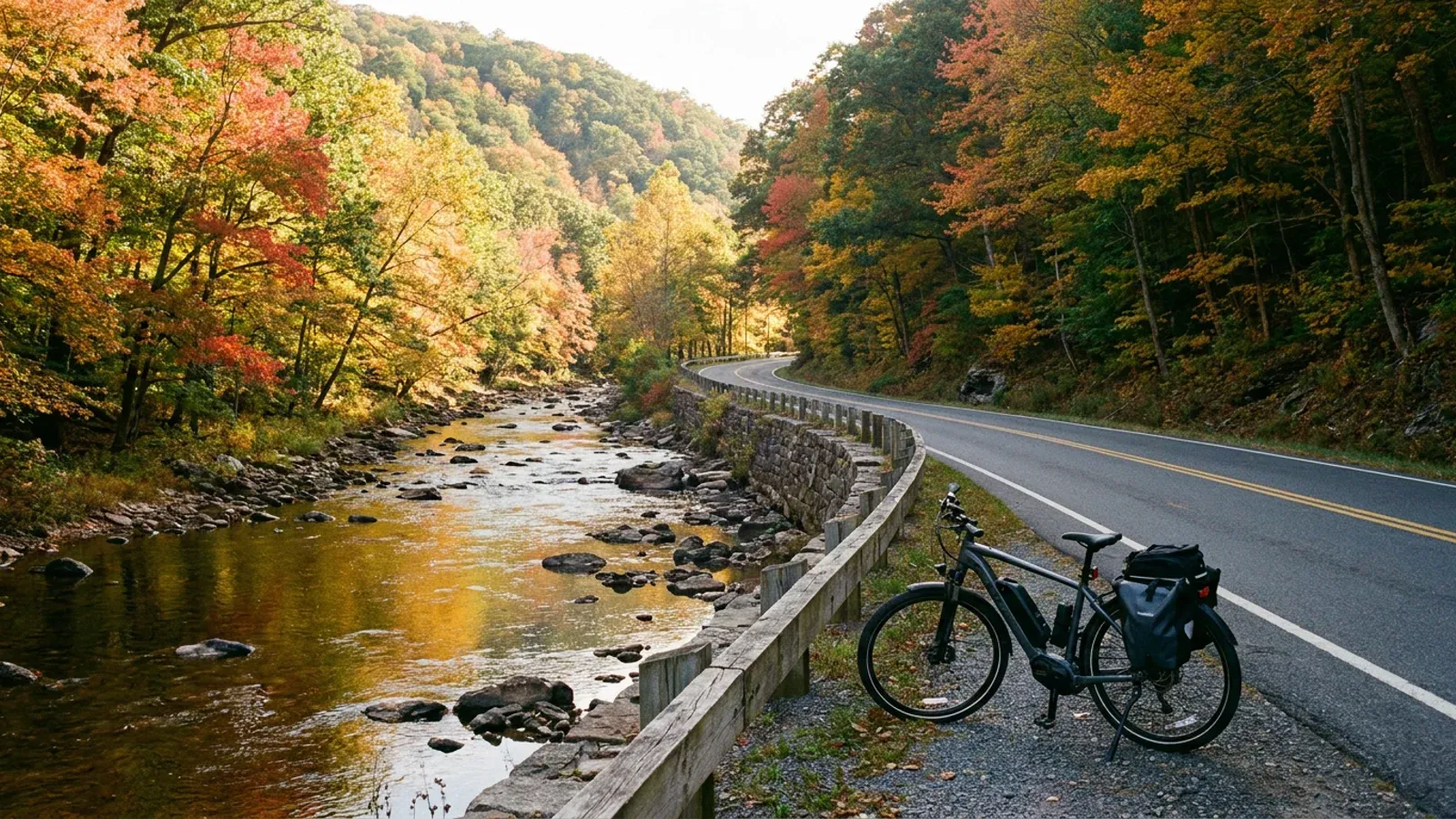
A hill road in the Litchfield Hills of northwest Connecticut.
Compared with Hartford County, where the Farmington Canal gives a continuous paved path, Litchfield County rides are loops on public roads and short sections of a greenway.
1. Lake Waramaug loop
DEEP calls Lake Waramaug State Park a popular starting point for biking around the lake. The eight-mile circuit follows the lake's perimeter on Lake Waramaug Road and Shore Road, with water views and stops such as the Hopkins Vineyard.
Distance: 8 miles, per DEEP; start: Lake Waramaug State Park, 30 Lake Waramaug Road, Kent and New Preston; surface: Public roads, which DEEP describes as winding and narrow in places.
eBike access: This is road riding, so the ordinary bicycle rules apply, and the Class 3 trail ban does not come into play on the road. DEEP's park page says the roads suit confident cyclists with a thorough understanding of road safety, and it lists the park as open 8 a.m. to sunset. Etiquette and planning: Ride with lights and a mirror if you have one, and plan for narrow sections where cars cannot pass easily. Managing source: DEEP, Lake Waramaug State Park.
2. Burr Pond State Park, Torrington
DEEP lists biking among the park's activities and links to Trailforks mountain biking information, and it says the John Muir Trail links the park's Walcott Trail to 11.5 miles of trails in nearby parks. The park has a beach, picnic areas and a pond, and alcohol is banned.
Distance: DEEP gives no bike-trail distance; it cites 11.5 miles of linked trails in nearby parks; start: 384 Burr Mountain Road, Torrington; surface: Not published by the managing source.
eBike access: The park page gives (860) 482-1817 for the office and says the park is open 8 a.m. to sunset. It does not say whether electric bicycles are allowed on the trails, and a Class 2 is barred from a nonmotorized natural-surface trail unless a local ordinance allows it. Etiquette and planning: Stay off any Blue-Blazed trail, which DEEP closes to mountain bikers, and check the Trailforks page for the trails open to bikes. Managing source: DEEP, Burr Pond State Park.
3. Naugatuck River Greenway, Litchfield County sections
The Naugatuck Valley Council of Governments describes the greenway as a non-motorized multi-use trail being developed for 44 miles through the river towns, including Litchfield, Harwinton, Thomaston and Watertown. It is built town by town, and the council says multi-use trails of this kind are typically 10 to 12 feet wide with a paved or hard surface.
Distance: 44 planned miles; the council does not publish the length of the open sections on its page; start: A mapped access point; the council points to a CT Trail Finder map of open sections; surface: The council describes multi-use trails in general as typically 10 to 12 feet wide with a paved or hard surface, and gives no surface for each open section.
eBike access: The council's page calls the finished trail non-motorized and multi-use and does not give an e-bike rule, so check each town. The greenway is a sequence of separate sections, and it says plans to connect them are underway. Etiquette and planning: Do not expect a continuous ride; use the council's map to find the open sections before you load the bike. Managing source: Naugatuck Valley Council of Governments, Naugatuck River Greenway.
Planning a Litchfield County ride
The Lake Waramaug loop is the easiest first ride, because its length, roads and park hours are all published by DEEP.
Half-day and full-day eBike plans
Half day: Ride the eight-mile Lake Waramaug loop from the state park.
Full day: Ride the lake loop, then drive to Torrington to try Burr Pond's trails, checking Trailforks for the bike-open routes.
What not to ride
The Appalachian Trail and Blue-Blazed trails: DEEP's biking page says these hiking trails are closed to mountain bikers. Use a different route.
Kent Falls State Park trail: DEEP's page describes a short, steep stair path up the falls, not a bike route, so leave the bike at the lot.
When to ride Litchfield County
Start early in Litchfield from June through August, and carry water on any ride longer than a short loop.
Shop hubs
Listings in Litchfield County come from 8 towns. A town page gives the address and phone for every shop in that town.
- eBike shops in West Cornwall (1)
- eBike shops in Litchfield (1)
- eBike shops in Barkhamsted (1)
- eBike shops in Thomaston (1)
- eBike shops in Kent (3)
- eBike shops in New Milford (1)
- eBike shops in Harwinton (1)
- eBike shops in Watertown (1)
Rental and tour operators
The county's rental and tour cards are listed below; ring ahead to confirm electric models, helmet supply, and return times.
Covered Bridge Electric Bike🚲 Rentals
Bicycle Tour Company🎯 Tours
Connecticut eBike rules snapshot
Connecticut defines an electric bicycle in General Statutes section 14-1 as a bicycle with operable foot pedals and an electric motor of under 750 watts that is Class 1, Class 2 or Class 3, and it excludes a dirt bike or an all-terrain vehicle. Public Act 26-24, effective October 1, 2026, changes "fewer than" 750 watts to "not more than" 750. In Class 1 the motor engages only while the rider pedals and cuts out at 20 mph; in Class 2 it can propel the bike by itself and cuts out at 20 mph; in Class 3 it again needs pedaling and cuts out at 28 mph. The same section leaves electric bicycles out of the motor vehicle definition, so a bike that fits needs no license or registration. Public Act 25-159 says a motorized vehicle whose throttle can exceed 20 mph without pedaling, or one made to be reconfigured out of the definition by a switch, app or software change, does not count as an electric bicycle, and a seller must give buyers a written notice of that.
The riding rules are in section 14-289k as Public Act 25-159 rewrote it, effective October 1, 2025. An e-bike rider has a bicyclist's rights and duties and may ride wherever bicycles may ride unless a local ordinance says no. Class 3 bikes are kept off bicycle trails, bicycle paths and multiuse trails and paths. A Class 2 may not be ridden on a nonmotorized trail with a natural-surface tread unless a local ordinance allows it, and the 2025 act removed Class 1 from that ban. The online chapter page still showed the earlier wording when we read it on October 2, 2026, so we cite the act. No one under 16 may ride a Class 3, and a violation of the section is an infraction. Under section 14-289l, the manufacturer attaches a conspicuous label stating the bike's classification, maximum speed and motor wattage.
On helmets, subsection (f) of section 14-289k says no person may ride or sit as a passenger on an electric bicycle without a helmet that meets one of the named bicycle-helmet standards, with no age or class exception. A separate rule, section 14-286d, covers any child 15 or younger on a bicycle or e-bike on a highway or in any park. The statute says failing to comply with that child rule is not a violation or an offense, though an officer may warn a parent, and a rental business must provide a helmet to anyone under 16 who has none. Sidewalks fall under section 14-286: a rider must yield to pedestrians and sound a signal before passing, and sidewalk riding is barred wherever a local ordinance says so. The basics are in our Connecticut eBike laws guide, and a trailhead sign or town code overrides them.
State land adds its own layer. The Department of Energy and Environmental Protection's state park rules (Regulations of Connecticut State Agencies section 23-4-1) open trails to non-motorized multiple use unless posted closed and limit Blue-Blazed hiking trails to hiking, and DEEP's trail use page lists foot, mountain bike and horse use. Those rules were last revised in 2017, before the electric bicycle statute, and we found no DEEP page that says outright whether a Class 1 or Class 2 may use a given state park trail. DEEP's biking page tells riders to check with park staff if they are unsure which trails are open to bicyclists, and that is the question to ask before a ride.
A town can write its own rules. Section 14-289 lets a municipality regulate bicycles and electric bicycles by ordinance, and the legislature's Office of Legislative Research reported in 2024 that Greenwich and West Hartford restrict bikes on certain sidewalks (OLR report 2024-R-0154). Connecticut abolished county government in 1960, and since 2022 the Census Bureau has used the state's nine planning regions as county-equivalents (Federal Register notice). This directory still files each shop under the eight old counties, and a ride may cross several towns with different ordinances.
Where a trail sign, a town ordinance, a land manager or a park office says no eBikes, that rule controls. Each route below cites the group that manages it, and any fact we could not confirm is marked as unpublished.
DEEP's pages list its Litchfield County parks as open from 8 a.m. to sunset, and under the state park rules a trail is open to non-motorized multiple use unless it is posted closed. A town's greenway section follows that town's own rules, which the Naugatuck Valley council's page does not summarize.
Frequently asked questions
How long is the Lake Waramaug loop?
DEEP gives eight miles around the lake on Lake Waramaug Road and Shore Road.
Is the Naugatuck River Greenway finished?
No. The council says the trail is being developed for 44 miles, and that work to connect the existing sections is underway.
Can I mountain bike on Blue-Blazed trails?
No. According to DEEP, the Blue-Blazed system is off limits to mountain bikers, as is the Appalachian Trail.
Can I use a throttle eBike on a natural-surface trail in Litchfield County?
The statute bars a Class 2 from a nonmotorized trail with a natural-surface tread unless a local ordinance allows it, and state park trails also have posted rules. Ask the park office first.
Do kids need a helmet on an eBike in Connecticut?
Yes. Section 14-289k(f) requires a helmet for every e-bike rider and passenger, and section 14-286d separately covers a child 15 or younger on a bicycle or e-bike on a highway or in any park. The child rule is not an offense by its own terms, though an officer may warn a parent. See the Connecticut eBike laws guide.
Is registration required for an eBike in Connecticut?
A bike that meets the Class 1, 2 or 3 definition is not a motor vehicle under section 14-1, so we found no registration requirement for it. A vehicle that does not meet the definition is a different case, and the seller must give the buyer a written notice saying so under Public Act 25-159.
All shops in Litchfield County
Every listing we hold for this county, 10 listings in 8 cities, is on the Litchfield County eBike shops page.