Cities Are Choosing 15 mph Trail Limits Over Class 3 Bans. Here's What Changes for Riders.
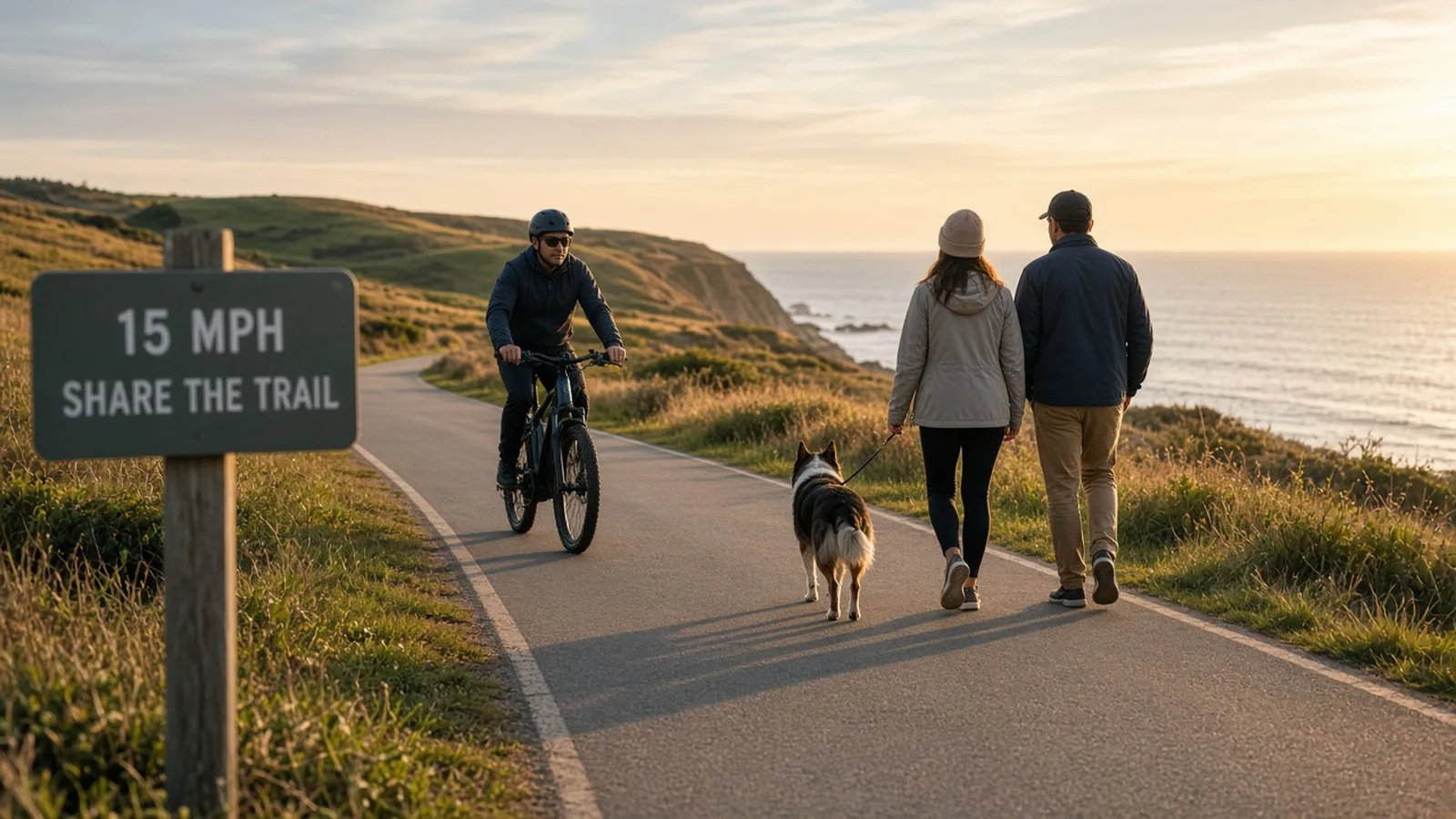
More shared paths are getting speed rules instead of blanket Class bans.
Short answer: Southlake, Texas (Oct. 6) and Fort Mitchell, Kentucky (Oct. 12) adopted 15 mph limits for e-bikes on sidewalks and, in Southlake, trails. Fort Mitchell also banned Class 3 e-bikes from sidewalks. Fort Bragg, California is moving toward a 15 mph Coastal Trail limit in place of a Class 3 ban, but nothing is final until its Oct. 26 hearing.
This post is general information, not legal advice. Check your city's ordinance before you ride.
If you ride a shared path, you know the moment. A quiet pedal-assist bike rolls past at jogging speed. A minute later something with the same "e-bike" label goes by a lot faster. Walkers flinch, and the complaints end up on a city council agenda.
In the past few weeks, three cities took up that fight. Their answer leans less on which Class of bike you own and more on how fast you go and where you ride it.
Fort Bragg is moving away from a Class 3 ban (nothing is final yet)
On the Mendocino coast, Fort Bragg had a draft ordinance that would have barred Class 3 e-bikes (assist up to 28 mph) from the Coastal Trail and every city park. Class 1 and Class 2 bikes, whose motors stop helping at 20 mph, would have stayed legal. The city's Community Development Committee recommended that ban in September.
At the October 13 council meeting, the council took no vote on the e-bike rules. Instead, according to The Mendocino Voice, members gave staff direction: a 15 mph limit for everyone with signs, "share the trail" painted on the path, more education, and dropping the Class 3 prohibitions. The council voted 5-0 to carry the public hearing over to October 26 at 6 p.m. so the city's contract planner can rewrite the ordinance. Until then, this is direction to staff, not law. The city's own notice for the hearing covers changes to Chapter 9.68 of the municipal code for the Coastal Trail and city parks.
The council was not unanimous on the idea. Council member Lindy Peters said a phone app can make Class 1 and 2 bikes go faster and backed a Class 3 ban "for now." Council member Scott Hockett called a Class 3 ban "an enforcement nightmare." Police Chief Eric Swift said the department does not get a lot of complaints about scooters or e-bikes. About a dozen people spoke, and several backed a speed limit over banning one class of bike.
Southlake and Fort Mitchell already voted
In North Texas, the Southlake City Council approved Ordinance No. 735C on October 6, an update to its bicycle ordinance covering e-bikes and electric scooters. It sets a 15 mph limit on sidewalks and trails and bans bikes, e-bikes and motorized scooters from sidewalks in the Town Square District. Violations are typically Class C misdemeanors with fines up to $500, and three or more offenses can lead to impoundment. Riders need a front light and a red rear light or reflector. Parents are presumed responsible when their kids break the rules. The police chief said many of the complaints behind the change were about riding at night.
In Northern Kentucky, the Fort Mitchell council gave final approval to its e-bike sidewalk rules on October 12. Riders get a 15 mph sidewalk limit, must yield to pedestrians and give an audible warning before passing, and need a sound device audible from at least 200 feet. Class 3 e-bikes are banned from sidewalks entirely. E-bikes and scooters are off-limits in city parks except on park roads and in parking lots. Riders must walk their bikes through the Beechwood Road school zone for 45 minutes before school starts and 45 minutes after dismissal. Fort Thomas passed its own ordinance in late September, and Alexandria, Florence, Union and Covington are considering or have enacted similar rules.
So in the same stretch, one city is heading toward a single speed number for everyone, and another paired a speed number with a Class 3 ban on its narrowest, most crowded spaces.
Why Class rules still matter on some trails
Class labels are not going away. A bike that assists to 28 mph is a different machine on a crowded path than one that stops at 20. In Maryland, Montgomery Parks opened designated natural-surface trails to Class 1 pedal-assist e-bikes and adaptive mountain bikes in June, while Class 2 and Class 3 bikes stay banned from all of its trails. The reasons it gives are trail damage, speed and safety.
The case for speed limits is practical. From the sidewalk, you often can't tell a Class 1 from a Class 3, and some bikes can be tuned past their label. A posted 15 mph limit applies to whoever is passing the dog walker too fast, whatever the motor is rated for. That's the argument Fort Bragg's council kept coming back to.
What this means if you own or are shopping for a Class 3
None of these rules make a Class 3 illegal to own. They change where and how fast you can ride it, and a speed cap can apply to your Class 1 too.
- Check the rules for the exact path you ride. State law defines the Classes. City codes and park agencies decide where each one can go and how fast anyone can ride.
- Assume a posted 15 mph limit means you. Unless the sign says otherwise, your Class sticker is not an exception.
- Treat sidewalk rules separately. Fort Mitchell's Class 3 ban covers sidewalks. Southlake's Town Square ban covers one district's sidewalks.
- Get lights and a bell or horn. Both new ordinances require lights, Fort Mitchell requires a sound device, and Fort Mitchell requires helmets for riders under 18.
- Ask a local shop before buying a Class 3 because a listing says "trail ready." That usually describes the tires, not where the bike is legal.
Riding around Southlake or Fort Worth? Start with our Tarrant County shop guide or the Fort Worth e-bike shops page. For the Class definitions, keep our 50-state e-bike laws guide handy.
These rules didn't invent shared-path conflict. They show how cities are handling it: fewer blanket Class bans where enforcement is hard, and more rules about speed, yielding, lights and walking your bike where people are on foot. Check the ordinance for the path you ride before you head out.
Sources: The Mendocino Voice, Oct. 14, 2026; City of Fort Bragg public hearing notice, Chapter 9.68 (Oct. 1, 2026); Southlake City Council agenda, Oct. 6, 2026 (Ordinance No. 735C); The NE Tarrant Record, Oct. 8, 2026; NKY Current, Oct. 14, 2026; Montgomery Parks, June 22, 2026.
Frequently Asked Questions
Did Fort Bragg ban Class 3 e-bikes on the Coastal Trail?
No. On Oct. 13, 2026 the council took no vote on the e-bike rules. It gave staff direction toward a 15 mph limit for everyone and dropping the Class 3 prohibitions, and carried the hearing to Oct. 26 at 6 p.m. Nothing is final yet.
What is the fine for breaking Southlake's e-bike rules?
Violations are typically Class C misdemeanors with fines up to $500, the police chief said. Three or more offenses can lead to impoundment.
Are Class 3 e-bikes allowed on Fort Mitchell sidewalks?
No. Fort Mitchell's ordinance bans Class 3 e-bikes from city sidewalks entirely and sets a 15 mph limit for other riders on sidewalks.
Riding in North Texas?
Find a local shop that knows the rules for the paths you ride.
Tarrant County eBike Shops → eBike Laws by State →